Showing posts with label diaspora. Show all posts

Friday, May 22, 2009

Au Pinoy

My friend R has taken up the issue of Filipina au pairs in Denmark. He wrote to me on Facebook recently. An extract from his message:
Sometimes,

I become angry. Or sad. Or something inbetween.

When I look at how the different Filipino organizations here in Denmark are working against each other. Competing. All wanting to be "alpha male", so to speak. So they don't share information easily. And the only real losers are the members of those organizations, or, more acutely, those who are Outside those organizations. Who don't belong to any of those networks.
...

Sometimes I wonder why they seem to be so focused on the church (im Not against the church), or their karaoke, or their social meetings, when so many other things - the very foundation for their visa here in Denmark, or, rather, those who come here after them - is all in the air.

Messages went back and forth. I tried to explain the fatalistic attitude, even the gap between Pinoy students and au pairs. I want to be involved in the discussion. If you also do, visit Au Pinoy to know more.

Saturday, November 17, 2007

Lectures@LSE

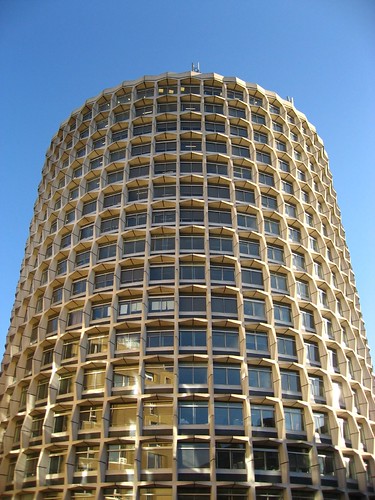
round tower
Two great lectures at the London School of Economics were also opportunities to chat with Jon, who's an LSE alumnus.

Global Media System, Public Knowledge and Democracy
Speaker: Professor James Curran, Media Research Programme Director, Goldsmiths, University of London
Click here for the podcast (20 mb; approx 86 minutes)

A four-country study showed interest in current affairs to be the single most important correlate of knowledge, with gender and education as strong predictors. However, as Curran argues, the "tectonic shift in organisation" of the media--privatisation, de-regulation, market liberalisation, and the decline of public broadcasters--are turning audiences from citizens into consumers, with worrying consequences, as showed by findings in the US. Americans know less in general about public affairs than the British, Finns and Danes. Finland and Denmark have dominant public broadcasters, Americans mainly private, while the British are in between. My theory is that there is less to do in Finland and Denmark, hence they watch more TV. Care to rebutt that? ;)

But really, there could be a lot of reasons for the differences, including the multicultural society of the US. This points to possible problems in access and differences in the culture of watching and reading the news.

Sonia Livingstone chaired the lecture.

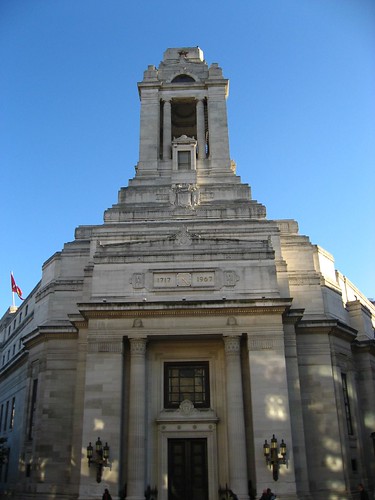
freemasons hall

Migration and Social Transformation
Speaker: Professor Stephen Castles, Co-Director of the International Migration Institute and Professor of Migration and Refugee Studies at the University of Oxford
Click here for the podcast (22 mb; approx 95 minutes)

Castles very ably took us through key issues in migration studies, talking about the ambivalence about the growth of migration studies and stressing the need for caution. The failure of migration policy and the reinforcement of 'methodological nationalism' in the social sciences are reasons for pessimism. However, once migration is acknowledged as both the result and cause of social change, we can begin to see that globalisation transforms the conditions for migration and then dismiss 'conventional wisdoms'.

We managed to have a word with the professor at the reception after the lecture. He identified us as Filipinos because we were cracking up (couldn't help it) when he mentioned the Philippines as being an interesting case, because Marcos started migration to fight change, not develop the country.

One point he mentioned about the Philippines is the structural dependency on migration. For us, it's normal to go abroad. So true. And the situation replicates itself. While mobility and the freedom to seek better conditions are human rights, there are flaws in the system. No space here to discuss this but you get the picture.

The lecture marked the inauguration of LSE's Migration Studies Unit. It was unfortunate that David Held, who was scheduled to chair the lecture, was ill and couldn't make it. Held is one of the key figures in globalisation studies.

About the photos
These are buildings near the LSE. Big structures, bigatin figures in the academe. Hahaha!

Monday, October 22, 2007

Tea time + Pinoy UK get-together

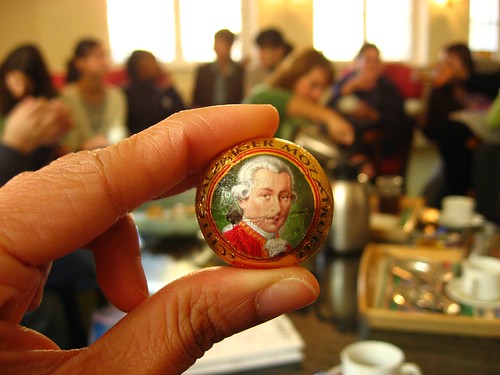
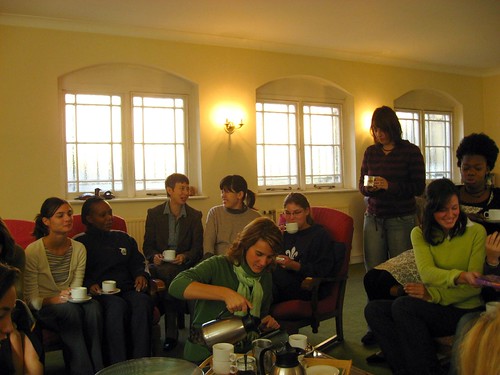
Mozartkugel, anyone? Here are scenes from tea after Sunday lunch. D brought chocolate from Austria.

Most of the weekend was spent online, working on my dissertation.

On Saturday afternoon, I went with Ria to the Pinoy get-together where I met schoolmates past and present.

I was half-asleep on Sunday morning, so when A whispered "Fancy reading?" to me at the oratory, I barely processed what she said. My mind was still asleep that I didn't know what was coming out of my mouth. That was probably one of the few times I felt disconnected to my body. The eyes processed the text but the words went directly to the lips, bypassing the brain, resulting in a couple of booboos. That's what you get for having Mass before breakfast!

Friday, October 12, 2007

SOAS Centres launch

Two new SOAS centers, the Food Studies Centre and the Centre for Migration and Diaspora, were launched yesterday evening with a lecture from Professor Sidney Mintz of Johns Hopkins University.

Prof Mintz, best known for his work Sweetness and Power: The place of sugar in modern history, gave an excellent talk about how food makes culture and the influence of food from the New World on the cuisine of the Old World and vice-versa. Great cuisines do not happen in isolation. "Keep locality and culture in mind," he advised the capacity audience at Brunei Gallery. We were then treated to spicy foodstuffs migrated from Tooting.

Tuesday, September 11, 2007

Diaspora, Media and Migration

Nothing vaguely academic in this post, sorry.

With a nametag that said "University of London", I felt like an impostor. Self-conscious that everyone at the ECREA conference but me was either doing their PhD or was a researcher or professor, I felt small. Being new to the field, I came to soak up the spirit of others who were devoted to this area and came out inspired by their dedication and personal commitment. While there is much work left to be done, the trail has been marked and the seeds of inquiry sown. It was a privilege to be in such good company.

Can I start writing my dissertation now? I think so.

Saturday, August 25, 2007

The Malu Fernandez issue

A lesson in journalistic responsibility, dignity of labor and simply, respect.

While it is tempting to do a recap from a cultural studies point of view, enough has been written about this, so I will hold my tongue, pen and keyboard. Regardless, this scandal, if you want to call it that, is still worth mentioning because it concerns OFWs and, should I say, class relations. For updates, or even the entire story, scroll from the bottom up at Pinoyblogosphere and make your way through the entire array of reactions.

One last thing: fight insults with reason, not with more insults. Karma or no karma, we have to be more mature than that.

Monday, August 20, 2007

Visa rule changes put care homes on alert

An article from today's The Guardian. This paragraph struck me.

Few EU migrants would be suitable to fill the jobs because they would lack the nursing, caring and English language skills of Filipino workers. Relationships which many carers had established with residents could be upset.

When amended, visa rules (which are complex in themselves) have complex effects that need to be anticipated.

Read entire article here.

Saturday, June 23, 2007

Taming the sea snail

From Forbes.com
Poison Pill
Dennis Posadas

Venom from sea snails is used to treat chronic pain and may soon yield new drugs for Parkinson's and other brain disorders.

As a boy in his native Philippines, Baldomero Olivera spent countless hours scouring for seashells on the beach. Once he'd made his finds, he'd rush home and pore over marine-life books to identify his treasures. He was particularly intrigued with cone snails, beautiful but deadly sea snails that kill their prey with venom. Thirty years later Olivera's fascination with cone snails would open a new pipeline of drugs for discovery.

Read more

Thursday, June 7, 2007

Migrants Day

Today Filipino migrants mark the anniversary of the passage of Republic Act 8042, the Migrant Workers Act of 1995.

Four days ago, President Gloria Macapagal Arroyo attended the canonization of the foundress of the Religious of the Assumption, Blessed Marie Eugenie, and three others: Blessed John Andrew Houben, Blessed Lipnica Murowana of Poland, and Blessed George Preca of Malta. GMA is an alumna of Assumption Convent. Though I'm proud to say that I also attended a school in the RA system, knowing that she graduated from a sister school does not make me proud.

Interestingly, the heads of state of Poland, Malta and Ireland were there. That of France, where Blessed Marie Eugenie hailed from, wasn't. So GMA is a stand-in for Sarkozy now?

Anong konek? An earlier report said this:
Militant Filipinos working and living in Italy and other parts of Europe are poised to hold protest rallies against Ms Arroyo in Rome.

The visits to Italy and Portugal were part of a public relations blitz to repair the country’s “tarnished image,” said Migrante International.

“The Rome visit is [meant] to get the Catholic Church’s blessing for her criminal regime … and to drum up political support for her regime’s greater diabolical plans to perpetuate fascist rule through the newly passed antiterror law,” said a statement from the group’s European-based affiliates.

According to Migrante, the defeat of the administration senatorial candidates in the overseas absentee voting was “a clear message” to Ms Arroyo “that she is already exposed, that Filipino migrants do not want her anymore, and that they are willing to take militant action to lobby their host countries and governments to stop the political killings and abductions, and to stop foreign aid to her regime.”

The three groups also condemned alleged cheating in the May 14 elections and the Arroyo administration’s supposed efforts to ensure the failure of another impeachment attempt against the President and the success of Charter change.

Before a private audience with the Pope, GMA seemed to pacify some Pinoys at the Fontifico Colegio de Filipino when she announced that the the passport fee at the Philippine embassy in Italy has been reduced from €65 to €50 and the authentication fees from €32 to €25, and that Philippine driver's licenses will be honored in Italy. Report here .

Gloria, Gloria, you will have to do better than that.

Tuesday, May 29, 2007

Is this the future of househelp recruitment?


laborfair calls itself a "househelp referral community". I can imagine this business concept sprouting wherever there is need for domestic labor and becoming a franchise. Any takers?

[via Springwise]

Tuesday, May 15, 2007

Say Chiz?

I am neither pro-Chiz nor anti-Chiz, but Francis Joseph "Chiz" Escudero has many fans and believers. His political career seems made. He is leading the latest counts from yesterday's senatorial elections, according to Inquirer.net's Eleksyon 2007 blog.

That said, I just wanted to share my dad's Chiz anecdote. They were both waiting at what used to be Monique Wilson's Paco home, where we were having rehearsals for a show. My dad asked him "Sinong hinihintay mo, anak mo?" (Who are you waiting for? Your kid?) Turns out he was waiting for his then-girlfriend now-wife Christine.

I honestly didn't really think about who I'd vote if I was in the Philippines. (Just repeating my comments on other people's blogs here.) I'm not an Overseas Absentee Voter (OAV), so I'm really just a spectator of the carnival, where the issues are only sideshows--Bakhtin would be impressed. (Or horrified.) Not that I don't care. But the distance makes me feel...distant from it all. Maybe other Filipinos abroad feel the same way, hence the low turnout of OAVs. It could be something else. They could have become jaded, disillusioned, fed up, indifferent. I hope I will not feel that way about my homeland. Sadly, it's all too easy for that to happen.

Wednesday, May 2, 2007

Dispersed


Since I couldn't come to Bianca's despedida last Thursday(and I don't have Photoshop), here's a Dreidels diptych.

I wouldn't be surprised if one day soon, I'll be here in Europe, Jamie in Japan, Anne in Australia and Bianca in the US. See you all in Africa in 2010! Hahaha!

Sunday, April 29, 2007

The reality of human trafficking

A PDI special report on a Filipina rescued from sex slavery in Ivory Coast. It makes my heart heavy.

Monday, April 23, 2007

"A Good Provider is One Who Leaves"

New York Times article on OFWs (Overseas Fiipino Workers). Thanks to Indi for the heads-up.

Trouble loading the blog? If the embedded stuff are slowing your computer down, just let me know.

Tuesday, March 13, 2007

The welfare state


A few weeks ago, I asked my classmate Maike why she came to Denmark and plans to stay here. She said that despite the high taxes and cost of living, she thinks that there is a better future here than in her native Germany where there is high unemployment and graduates go from one unpaid internship to another but don't get hired.

There are pluses to living here. Healthcare and education are free. If you're Danish, you can study at university for nothing. But the system is never perfect. There are complaints about good medical treatment and facilities. Eventually, education might have to be paid for.

The Philippines cannot adopt a system like this simply because of the money it needs to finance such a set-up. Can you imagine all hospitals working like PGH? It would be crazy. It's hard enough to get most people to pay their taxes, even harder to get the taxes to work for the people instead of lining some guy's pockets.

I talked to one of the pioneer Filipinos here, a pensioner who came to DK 39 years ago and now shuttles back and forth from Pinas. According to him, the Pinay au pairs cannot get professional work here and can only stay for the duration of their contract (which explains why most of them are young). Life in Denmark is not as easy as it used to be, but there are plenty of jobs, he said. He encouraged me to keep studying. I said that I will, but I have no plans of staying here.

Immigration is a different issue. It's still very much a homogenous society, but that is slowly changing. I don't know how effective the law that prohibits Danes from marrying a foreigner below 24 years old is. There was a girl at the embassy in Manila who was saying that she just turned 24 and she can now go and marry her old Dane. But then that also happens elsewhere in the world, except that in this case it's interracial and somehow it looks suspect.

Many Filipinos would probably think the same way as Maike. Denmark might hold the kind of future they only dream of. But if you look at the 10,000-strong Filipino community here, most of whom are working just to send money back home, maybe they would still rather live where their families are.

(Took this photo in Roskilde weeks ago. We now get two-digit temps in the middle of the day. Yesterday I could walk outside in a jumper, no coat necessary.)

Wednesday, December 6, 2006

Pasko sa Philippine House


Hanapin ang bandila't mga parol.

The Philippine Ambassador to the United Kingdom hosted an early Christmas party for Filipino students in the UK at his residence on Kensington Palace Green (lovely, lovely area). We had Filipino food: pancit malabon, sapin-sapin, empanada, tokwa't baboy. A group called UMPUK performed a balagtasan that debated whether Filipinos should stay in London. There was also a raffle where practically everybody won something.

It was interesting to meet fellow students and find connections with them. There's the LSE student who was from my high school, the IoE grad student who used to work at our telco client, the two Communication graduates who were ahead of me in Ateneo: one worked in fashion and dealt with our magazines; the other is going to meet David Buckingham of IoE and plans to teach at the Comm dept.

More proof that the world is small? Irene, a Filipina involved in The Work, who used to live in Ashwell and is the daughter of the consultant in the company my dad works for (whew) was free that evening. She had been planning to meet me eversince I arrived here. She lived very near the Embassy (and actually used to work there), so we had dinner--pasta at an Italian place at Queensway. We had a lot to talk about in the span of two hours. Forgot to take photos, but she's coming to the carol concert.

We do need the practice, but it was a blessing that we didn't have choir that afternoon. We practiced onstage last night. It's a big hall, so we will need some mics.

Friday, November 24, 2006

World's best and Studying overseas

[Late, but better than never. These two articles are from Michael Tan's Pinoy Kasi column in PDI. Please, please read them. I thought of taking photos of the six London unis in the top 100 to go with the post, but looking at the rankings makes me want to stay inside my room and study harder. My two pence worth on this (and yes, I am screaming): MORE SCHOLARLY RESEARCH! APPLY FOR SCHOLARSHIPS!]

World's best
By Michael Tan
Inquirer
Last updated 00:10am (Mla time) 10/25/2006

Published on Page A15 of the October 25, 2006 issue of the Philippine Daily Inquirer


SOME time back, i rote about the ratings of Asian universities given by Asiaweek magazine. Sadly, Asiaweek has closed down, so I thought we would no longer be able to compare universities in the region.

But it turns out that there are global surveys as well, one of which was just released last Oct. 5. This is the Times Higher Education Supplement-Quacquarelli Symonds (THES-QS) World University Rankings. With thousands of universities in the world, it is an honor to make it to this list, which is based on several criteria, including faculty-to-student ratios and ratings given by more than 3,000 academicians and 700 leading international employment recruiters.

How did the Philippines fare? I'm going to keep you in suspense and just say, for now, that four of our universities did make it to the top 500 universities.

Global ranks

Let's look first at the THES-QS list of 20 leading universities. Note that there are ties so there might be occasional skipping of numbers: Harvard (1st), Cambridge (2nd), Oxford (3rd), Massachusetts Institute of Technology and Yale (tying for 4th), Stanford (6th), California Institute of Technology (7th), University of California in Berkeley (8th), Imperial College London (9th), Princeton (10th), University of Chicago (11th), Columbia (12th), Duke (13th), Beijing University (14th), Cornell (15th), Australian National University (16th), London School of Economics (17th), Ecole Normale Superieure (18th), National University of Singapore and Tokyo University (tying for 19th).

Most of the universities are American and British, but there is also representation from Australia, France, China, Singapore and Japan. Most of the leading American universities are private; in fact, on that top 20 list, the University of California Berkeley is the only American public institution. When I went on to the top 500 universities, I found that in
all countries of the world, with the glaring exception of the United States and one other country (which I'll name later but which you may have guessed), state universities lead in the rankings.

Asia's best

I decided to pull out the Asian (to include Australian) universities from the THES-QS list and found that among the world's 500 leading universities, 90 are from Asia. Japan leads with 28, followed by China (including Hong Kong) with 16, Taiwan with 8, South Korea and Thailand with 7 each, Malaysia, Indonesia and the Philippines with 4 each, Australia with 3, Singapore with 2 and Bangladesh with one.

Do be careful with those figures since it's not just a numbers game. Australia and Singapore have few universities on the list, but they are all high up in the ranking.

Enough with the suspense. Let's look at how the Philippines did. The University of the Philippines (UP) came in 299th globally and 47th among Asian universities. I have to say that's not too bad, considering how UP has had to plod along with shrinking budgets and with the flight of so many good professors. Trailing behind UP were three private universities: De La Salle (392nd), Ateneo de Manila (484th) and, talk about a photo finish, the University of Santo Tomas at 500th.

Lessons

Instead of bombarding you with more numbers, I'm going to analyze those rankings and spell out three important implications for our own educational system.

First, you don't need to be a rich country to have good universities, India being the best example. Even before independence, Indian nationalists had formed a commission to plan out their future and early on, they sought to form a network of science and technology institutions. After independence, funds were put in to establish a whole network, with several Indian Institute of Technology (IIT) campuses. IIT ranked 57th in the THES-QS global list.

Indonesia, a country less developed than the Philippines, is another example. It had three universities, all state-run, beating us in rankings: University of Indonesia (250th), Bandung Institute of Technology (258th) and University of Gadja Mada (270th).

Second, the other countries seem to recognize that excellence in education must be spread out throughout the country. Note that our four best universities are all in Metro Manila. In contrast, the Indian Institute of Technology has campuses in several states, all of which fared quite well when Asiaweek rated each unit back in 2000. The three Indonesian universities I just named are all on the island of Java, but at least they're found not just in the capital, Jakarta, but also in Bandung and Yogyakarta.

Thailand's best universities -- Chulalongkorn, Thammasat, Mahidol, Kasatsart, Chiang Mai, Khon Kaen and Prince of Songkla -- are all state universities and they are located in different parts of the country.

Third (and I've made this point time and time again), the state needs to invest in universities. The THES list is clear in showing that, with the exception of the United States and the Philippines, the leading universities in every country are state-owned. Sure, UP is the leader in the Philippines, but in other countries, several state universities – not just one -- made it to the THES list.

Most governments in the world have the wisdom to look at education as something too important to leave to "free market forces" (read: "profit"). Unless we learn from them, we will continue to see more diploma mills, more scandals in licensure exams and more Filipinos having to work overseas as cheap labor to develop other countries. Note that the THES-QS rankings also relate to international competitiveness, meaning if you graduate from those that lead in the rankings, you also stand a better chance of getting a well-paying international job.

UP is still among the world's best, but if we worked harder on the entire educational system, we should have more reason to be proud. Ultimately, we should be able to look at these university rankings as indicators of our current development strategies, as well as predictors of the country's future.

Studying overseas
By Michael Tan
Inquirer
Last updated 01:22am (Mla time) 11/10/2006

Published on Page A13 of the November 10, 2006 issue of the Philippine Daily Inquirer

WITH the economy the way it is now, you might be wondering why I'm bothering to write about the possibilities of studying overseas.
First, I'm still getting inquiries about the Times Higher Education Supplement's World University Rankings, which I featured last week, from friends who want to know where to send their children. OK, so those are the rich ones and therefore does all this have relevance to the average Filipino family? It does.
The other reason I'm doing this column is that I've learned, over the past few months, that there are few takers for several scholarships being offered by Japanese, Australian, Singaporean and European universities.
Filipinos tend to get intimidated by these scholarship offers, thinking they have to be at the top of their class, excelling in all fields. You'd be surprised at who gets scholarships: quite often, all it takes are average grades accompanied by a strong dose of self-confidence as you write your resumé and your reasons for applying. But don't overdo your self-confidence; many of these agencies also practice affirmative action, meaning they will give preference to those from poorer families, those living outside Metro Manila and those belonging to minority groups, particularly Muslims and indigenous communities.
Now, please, please do not write me for more information about whom to contact. You need to exert some initiative here and prove you know how to look for the scholarships. Your best bets are to write the embassies, but you can also check the Internet for other scholarships, for example, by looking for the Erasmus scholarships offered by European countries.
For upper-income families, you might be surprised to find out that the cost of studying in some of these countries isn't actually quite as high as you think. The way private schooling costs have soared in the Philippines, it may actually be cheaper to study overseas, even with the cost of living factored in.
Why overseas
We do have good universities here, but there may be cases where an overseas education might still be useful. First, and this applies more for graduate studies, foreign universities might have courses that we still don't have here. That was what happened with me: I took medical anthropology at the University of Amsterdam since we didn't have that in the Philippines.
Second, living overseas allows an exposure to other cultures, and that itself can be a learning experience. That might even include the university teaching styles. I still remember the excitement I had as a college undergraduate in the United States, thrilled by the much freer discussions that teachers allowed, and the range of subjects one couldtake.
Third, overseas universities (even those in neighboring countries) often have better facilities and learning environments. My parents always told me, when I was in college, that it didn't really matter which university you studied in as long as you had the right environment and the right teachers. Most of our universities have that, to some extent, but it's becoming more and more difficult to survive with underpaid, overworked professors who vent their frustrations on students. Paradoxically, it's the brighter kids who end up most alienated without the proper environment. An overseas stint, even for a year, might be an option.
Which universities?
OK, so which universities? I will go back to the Times Higher Education Supplement's World University Rankings that I mentioned in previous columns to give you the 10 best universities for each of several countries you could consider. Note that these rankings are based more on peer review among educators, and among employers.
Also remember that there will be language proficiency requirements for Japanese and Chinese universities. It also tends to be very competitive getting into the undergraduate programs of some of these countries, where education is subsidized by the state.
Finally, don't limit yourself to the universities listed here. Do more research to figure out where you can go. For American universities, check the US News and World Report's annual ranking. I paid only P189 for a 2006 edition in Books for Less! That yearbook has very detailed information. For example, with business programs, they break down the best universities for a range of specializations, from accounting and entrepreneurship, tointernational business and real estate.
Here now are the best universities for certain countries, with their ranking among world universities:
United States: Harvard (1), Massachusetts Institute of Technology (4), Stanford University (6), California Institute of Technology (7), University of California Berkeley (8), Princeton (10), University of Chicago (11), Columbia (12), Duke (13), Cornell (15).
Canada: McGill (21), University of Toronto (27), University of British Colombia (50), University of Alberta (133), McMaster (155), Queen's (176), University of Waterloo (204), University of Western Ontario (215), University of Calgary (266), Dalhousie (270).
United Kingdom: Cambridge (2), Oxford (3), Imperial College London (9), London School of Economics (17), University College London (25), University of Edinburgh (33), University of Manchester (40), King's College London (46), University of Bristol (64), School of Oriental and African Studies (70).
Australia: Australian National University (16), University of Melbourne (22), University of Sydney (35), Monash (38), University of New South Wales (41), University of Queensland (45), Macquarie (82), University of Adelaide (105), University of Western Australia (111), RMIT (146).
Japan: University of Tokyo (19), Kyoto University (29), Osaka University (70), Tokyo Institute of Technology (118), Kyushu University (128), Nagoya University (128), Hokkaido University (13), Waseda University (158), Tohuku University (168), Osaka City University (232).
For the bold ones willing to study a European language before applying, here are the best besides the British ones: Ecole Normale Superieure (18), ETH Zurich (24), Ecole Polytechnique (37), Sciences Po Paris (52), University of Copenhagen (54), Ruprecht-Karls-Universitat Heidelberg (58), Ecole Polytechnique Federale de Lausanne (64), University of Amsterdam (ahem, ahem, 69), University of Basel (75), Catholic University of Louvain (76).
To cap off this listing, here are the other higher-ranked Asian universities. Note how they rub shoulders with the best of American and European institutions: Beijing University (14), National University of Singapore (19), Tsinghua (28), University of Hongkong (33), University of Auckland (46), Chinese University of Hongkong (50), Indian Institute of Technology (57), Hongkong University of Science and Technology (58), Nanyang Technological University (61), Seoul National University (63).

Monday, November 6, 2006

Apat na Pinay


Nagkakila-kilala rin ang mga magkaka-eskwela. Had dinner with Marian, Joyce and Indi at Hare & Tortoise. Ang sarap mag-Tagalog!

A random passerby took this photo.

Tuesday, October 10, 2006

Four Asians at Hare & Tortoise


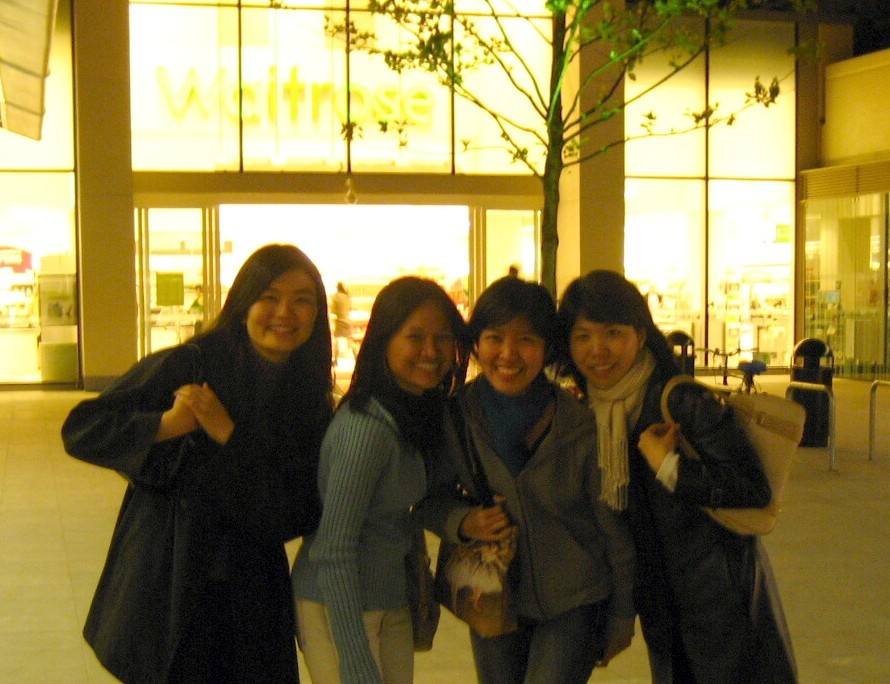
Two Japanese and two Filipino women--an interesting combination.

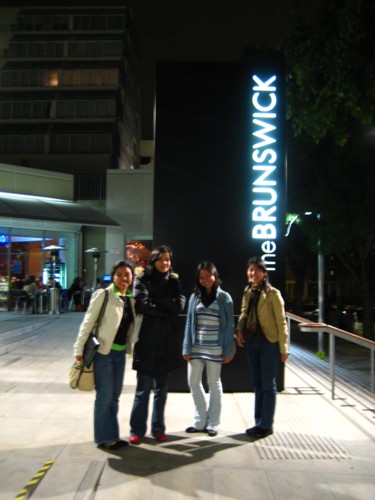
When I met Eka, Masako and Marian at the institute inductions, we instantly got along, just talking about Japanese pop culture. We had dinner at the Brunswick centre a few days later, discussing more seriously this time, touching on the future of Japan and the power of media.

Incidentally, Eka was approached by a Briton on our way to the bus stop. He said he had not eaten for three days, which we found quite odd because he was a huge man and looked perfectly alright. Eka said he smelled of alcohol.

This is us in front of the biggest Waitrose in London, also in Brunswick, near Russell Square station. Once all the shops open, it should be a beautiful, lively place.

Sunday, October 8, 2006

Another Pinay in London


I asked the woman with me in the school elevator if she was Filipino. Good thing I got a positive response. Joyce has been in London for two years now. She taught math in the Philippines and is now taking up Education while juggling two jobs. It turned out that we were both going to speak to Lizzie, the International Student Coordinator, so we waited for each other to have a chat in the student union cafe. (The union also runs a bar in school.)

Joyce told me to watch out for persistent men after relating the incident when a man semi-stalked her in Hyde Park. I told her that while she was in Lizzie's room, three men hoping to speak to Lizzie had talked to me, but I guess they couldn't wait so long because they saw that I was next in line. The first one was a Nepalese Erasmus fellow in Lifelong Learning; the second, a Pakistani LSE MBA student who wanted to ask something for his sister; and the third one, a Taiwanese Philosophy PhD student. Had they spoken to me in the street, I would have probably ignored them, but since we were in school, no harm done.

Joyce also narrated her backpacking trip with a friend across five European countries. Inggit ako!

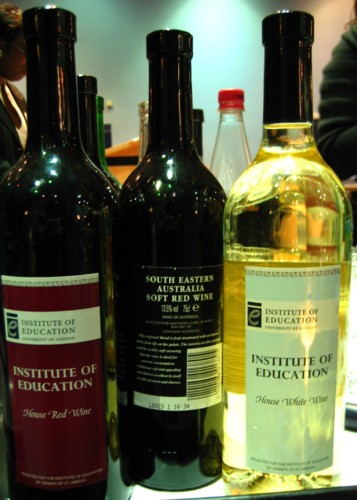
I took this photo during the programme induction in the evening. These are the wines served during functions. A matter of re-labeling, but the effort was still there.